Experiential Learning and Mental Health in Sports:
As I discusses the different instructional approaches, I reflected on the different types used throughout my instructional years. This doesn’t just include school, but other activities, including sports. Before completing the readings, I mostly thought of experiential learning as hands-on activity. While yeah, its definitely apart of it the learning mostly comes from multiple stages:
- Concrete Evidence – Engaging and hands on activity
- Reflective Observation – Reflecting the experience and connecting ideas
- Abstract Conceptualization – Elaborating on the reflection and reaching conclusions
- Active Experimentation – Testing and feedback of conclusions.
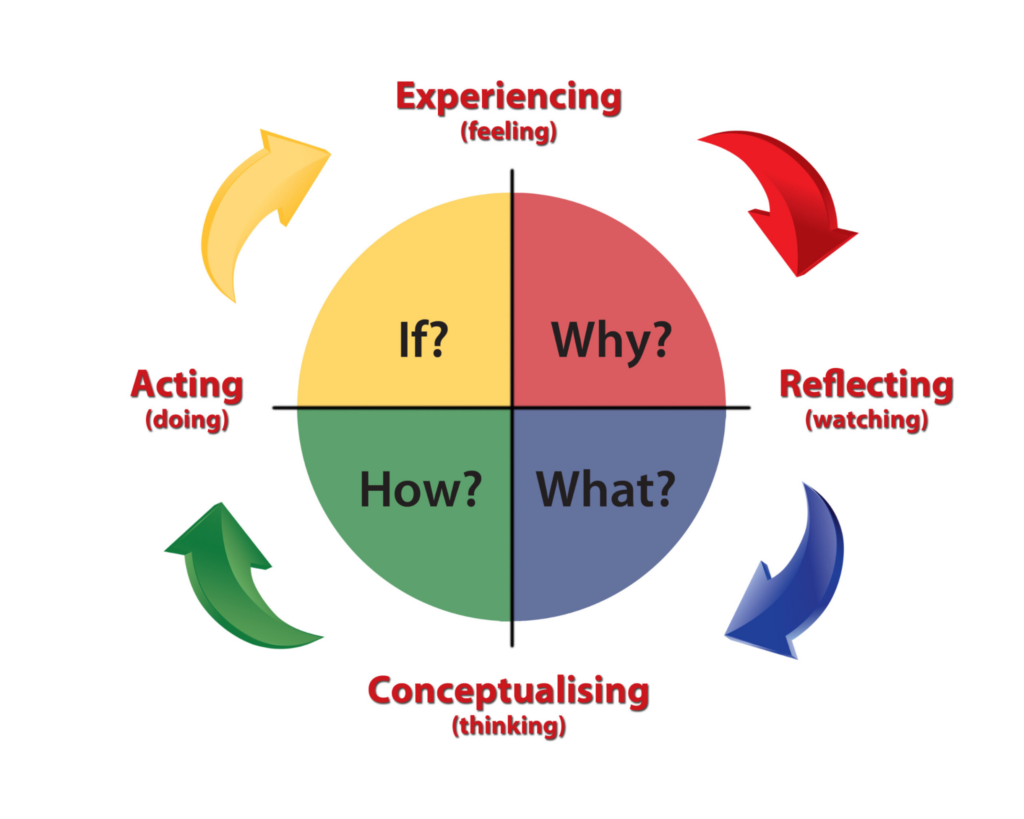
Parry and Allison (2020) discuss how experiential learning is often misunderstood as just any form of activity-based learning. They argue that experiences alone do not guarantee the student to learn, but instead, it happens when experiences are combined with reflection and feedback. This perspective stood out to me because of the importance of learners to critically think and reflect experiences rather than simply finishing assignments.
I think experiential learning aligns well with my topic of mental health in sports. Mental health is not something that can be fully understood by just memorizing definitions or textbooks, but first hand experience. Athletes face challenges such as performance anxiety, burnout, injuries, and pressure from others. Understanding these issues requires empathy and the ability to reflect on how mental health affects people.
If we were to use an experiential learning approach in our Interactive Learning Resource, learners could work through realistic scenarios involving athletes experiencing mental health challenges. For example, learners might analyze a case study about an athlete showing signs of body insecurities, than decide how they would respond from different perspectives. They could then reflect on their decisions and compare them with evidence-based strategies for supporting mental well-being.
Another aspect of experiential learning that I found interesting was its potential to develop social awareness and empathy though hands-on work.. Wieselmann et al. (2025) found that students involved in experiential learning developed deeper understandings of other people’s experiences. This seems especially relevant to mental health in sports, where supporting others requires understanding perspectives and experiences that may differ from our own.
After comparing the different instructional approaches discussed within our learning pod, I believe experiential learning provides the strongest support to our topic. By encouraging learners to reflect, apply knowledge, and engage with situations, it has the potential to create a deeper understanding of mental health in sport than traditional information-based approaches alone.
References.
Institution of Experiential Learning. (2023, October 14). What is experiential learning? https://experientiallearninginstitute.org/what-is-experiential-learning/
Parry, J., & Allison, P. (Eds.). (2019). Experiential learning and outdoor education: Traditions of practice and philosophical perspectives (1st ed.). Routledge. https://doi-org.ezproxy.library.uvic.ca/10.4324/9780429298806
Wieselmann, J. R., Sager, M. T., Scott, C. C., & Brown, S. M. (2025). STEM, sports, and service-learning: Exploring undergraduates’ experiential learning and social consciousness as summer program volunteers. Journal of Experiential Education. https://doi.org/10.1177/10538259251331584
Recent Comments