Category: edci335

Peer Review of Pod I

(Link to their draft – Learning Design Draft)

Overview:

This draft demonstrates a thoughtful approach to introducing learners to the topic of race, racism, and antiracism. The content is organized in a way that builds understanding very well, allowing learners to move from foundational concepts toward more complex ideas. As a learner working through the modules, I found the format logical and easy to follow. I really enjoyed the check in questions incorporated in each module, as I felt they truly allowed thought and reflection.

Strengths

The Contents Progression:

  • One of the major strengths of the resource is its clear progression. Beginning with an introduction to race as a social construct before moving into racialization, intersectionality, and antiracist action helps understanding and learning effectively. I appreciated how each module contributes to the overall understanding of the topic rather than feeling disconnected or an after thought. The use of summaries and knowledge checks also helps reinforce key concepts.

Engagement:

  • Another strength is multiple forms of engagement. The case studies, reflection prompts, and quizzes encourage active participation and help learners think critically about the concepts being presented. These activities support learning by requiring learners to apply information. I also found that the use of examples made some of the more abstract concepts easier to understand. 

Areas to improve

Learning Outcomes/feedback:

  • One area that you might consider strengthening is the connection between assessments and learning outcomes. I might have missed something, but it was not always clear which outcomes each activity was intended to assess. As well as rubrics/feedback for assignment could be clearer or more accessible. This will help students further understand what is expected for written assignments

Difference in interaction:

  • I also wondered whether there might be opportunities to increase learner interaction. Many activities involve individual reflection or quizzes, which are valuable, but you might consider adding opportunities for learners to compare perspectives or engage in student discussion, and share ideas/concepts with one another.. These additions could promote deeper learning and help learners apply their learning to their everyday.

Overall, I think this draft is excellent. The content is formatted well, the activities encourage engagement, and the topic is approached in a meaningful way. With stronger alignment between outcomes and assessments, as well as additional opportunities for interaction between peer/feedback, the final version will be very effective!
Post #4

When I searched my topic in the Youtube search engine, al TED Talk from an athlete about the hidden struggles athletes face with stress and anxiety was chosen. Its a great video for my topic because It can develop the topics ideas to be real, produces empathy, as well as invokes personal reflection. Bates (2022) suggest that video is incredible for bringing abstract concepts to life and giving them real-world context. It helps learners actually see and feel what is being discussed.

2. Learners Engagement

When students watch this, I don’t want them just passively watch. Instead I want them to pause, reflect, and take notes as they connect the athletes’ stories to their own understandings of sports culture. This kind of self-driven reflection naturally pushes them to think critically about how mental wellbeing and physical performance a one. It hooks their empathy, which Bates (2022) notes is huge for keeping learners genuinely engaged.

3. Applying

After the video, I want to them to enter a discussion which will ask them:

  • Identify one specific mental health hurdle from the talk.
  • Analyze how it realistically impacts an athlete’s life and performance.
  • Brainstorm a concrete strategy that coaches, teammates, or sports clubs could actually use to support them.

4. Feedback

Instead of a regular grading process, the feedback will feel like an ongoing conversation. Students will comment on each other’s posts to share new angles, challenge ideas, and support one another. At the same time, I’ll will also be offering support, guidance, pushing the depth of their analysis, and helping them tie their ideas back to our core course concepts. It keeps the digital classroom feeling engaging and collaborative.

7. Inclusion

To make this truly inclusive, I’m building in multiple pathways to the content. I’m making sure we have accurate closed captions, full text transcripts, and a clear written summary of the key takeaways. Whether a student is hard of hearing, deals with processing challenges, or simply absorbs information better by reading, these choices align with Universal Design for Learning (UDL) principles. At the end of the day, it’s about creating a learning space that is flexible, welcoming, and accessible to everyone.

Refrences:

Bates. A. W., (2022). Teaching in a digital age (3rd ed.). BCcampus. Chapter 8: Pedagogical Differences Between Media. BCcampus Pressbooks

Post #3

Reducing Barriers  – Prompt 3

In my interactive learning resource on Mental Health in Sports,  the Subtopic 3 focuses on helping athletes build strategies that support their wellbeing. One of the key activities in this section is the Personal Wellness Plan, where learners create a plan outlining stress‑management strategies and ways to seek support. When overlooking the project, we have to reduce barriers that unconsciously occur.

The biggest barrier is my activity may assume all students already know what a wellness plan looks like  or feel comfortable discussing mental health. My Blueprint states that learners will “create a wellness plan that includes strategies for managing stress and seeking support,” but many high‑school athletes may not have the background knowledge, vocabulary, or confidence to complete this independently or without research. Some may also struggle with organizing their ideas or may feel overwhelmed by the emotional content.

To reduce these barriers, I would redesign the activity using UDL principles:

  1.  Providing multiple examples of wellness plans in different formats, depending on how students learn perhaps a written template, a visual mind map, and a short video walkthrough.
  2. Include infographics about athlete mental health, such as visuals explaining stress responses, coping strategies, or the pillars of sports psychology. These support learners who process information better visually. 
  3. Offer multiple ways for students to express their wellness plan. Students are open to choose how they do the projects whether a written document, a short video, record an audio reflection, or design a visual plan.
  4. Including links to real mental‑health resources for athletes, such as the Canadian Centre for Mental Health and Sport or the IOC Mental Health Toolkit. Including short athlete videos,  like Simone Biles discussing mental health or Michael Phelps talking about anxiety.  This will normalize the topic and makes the students feel less alone/comfortable.

By adjusting the activity to assume learner variability rather than an “average athlete,” the Personal Wellness Plan becomes more accessible, more supportive, and more meaningful for all students.

Blog #2

Experiential Learning and Mental Health in Sports:

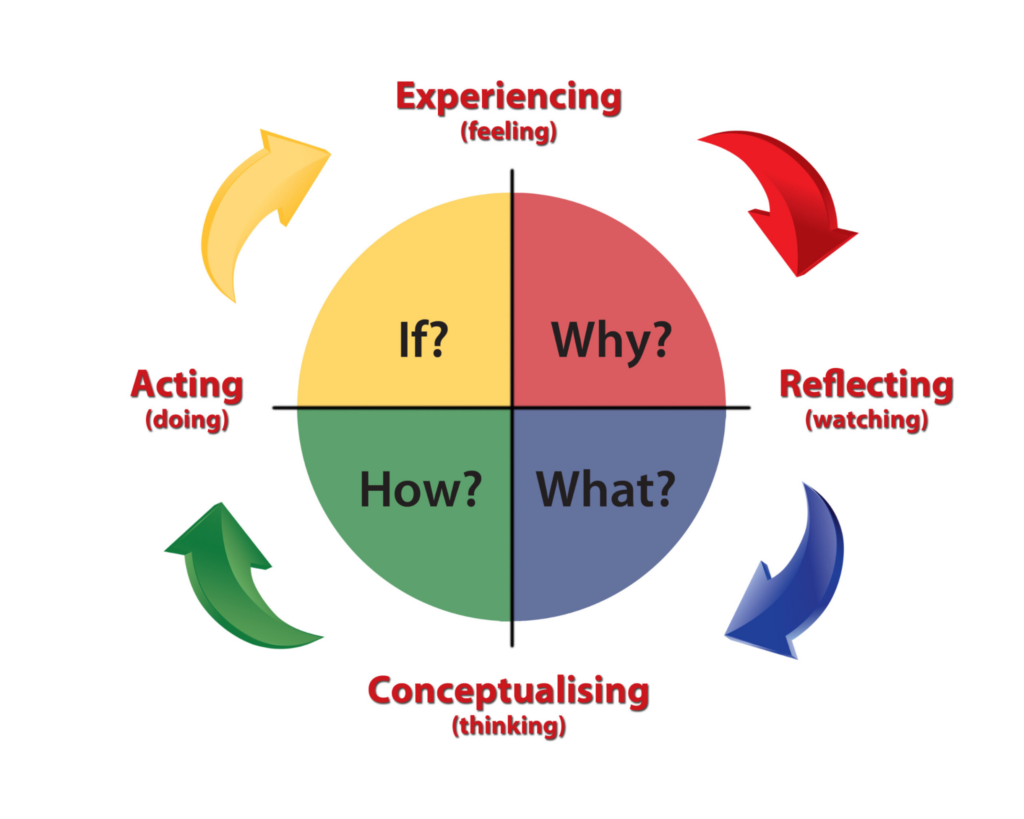
As I discusses the different instructional approaches, I reflected on the different types used throughout my instructional years. This doesn’t just include school, but other activities, including sports. Before completing the readings, I mostly thought of experiential learning as hands-on activity. While yeah, its definitely apart of it the learning mostly comes from multiple stages:

  1. Concrete Evidence – Engaging and hands on activity
  2. Reflective Observation – Reflecting the experience and connecting ideas
  3. Abstract Conceptualization – Elaborating on the reflection and reaching conclusions
  4. Active Experimentation – Testing and feedback of conclusions.

Parry and Allison (2020) discuss how experiential learning is often misunderstood as just any form of activity-based learning. They argue that experiences alone do not guarantee the student to learn, but instead, it happens when experiences are combined with reflection and feedback. This perspective stood out to me because of the importance of learners to critically think and reflect experiences rather than simply finishing assignments.

I think experiential learning aligns well with my topic of mental health in sports. Mental health is not something that can be fully understood by just memorizing definitions or textbooks, but first hand experience. Athletes face challenges such as performance anxiety, burnout, injuries, and pressure from others. Understanding these issues requires empathy and the ability to reflect on how mental health affects people.

If we were to use an experiential learning approach in our Interactive Learning Resource, learners could work through realistic scenarios involving athletes experiencing mental health challenges. For example, learners might analyze a case study about an athlete showing signs of body insecurities, than decide how they would respond from different perspectives. They could then reflect on their decisions and compare them with evidence-based strategies for supporting mental well-being. 

Another aspect of experiential learning that I found interesting was its potential to develop social awareness and empathy though hands-on work.. Wieselmann et al. (2025) found that students involved in experiential learning developed deeper understandings of other people’s experiences. This seems especially relevant to mental health in sports, where supporting others requires understanding perspectives and experiences that may differ from our own.

After comparing the different instructional approaches discussed within our learning pod, I believe experiential learning provides the strongest support to our topic. By encouraging learners to reflect, apply knowledge, and engage with situations, it has the potential to create a deeper understanding of mental health in sport than traditional information-based approaches alone.

References.

Institution of Experiential Learning. (2023, October 14). What is experiential learning? https://experientiallearninginstitute.org/what-is-experiential-learning/

Parry, J., & Allison, P. (Eds.). (2019). Experiential learning and outdoor education: Traditions of practice and philosophical perspectives (1st ed.). Routledge. https://doi-org.ezproxy.library.uvic.ca/10.4324/9780429298806

Wieselmann, J. R., Sager, M. T., Scott, C. C., & Brown, S. M. (2025). STEM, sports, and service-learning: Exploring undergraduates’ experiential learning and social consciousness as summer program volunteers. Journal of Experiential Education. https://doi.org/10.1177/10538259251331584

Prue Comments

JD1000 Blog 2

Hi JD,

I think you explained your experiences with Khan Academy very well, as well as the shift of relevance the further advanced classes became. Your point about motivation decreasing when the material no longer matches your more advanced needs makes lots of sense. I thought your idea about the platform spreading itself thin instead of fully developing certain subjects is a really thoughtful critique.

Blogpost 4: Manveen Kaur

Hi Manveen!

I really liked how clearly you explained the purpose of the probability video and how it fits into your ILR. Your point about using the video as an introduction before hands‑on activities came through really well, especially when you connected it to empirical vs. theoretical probability .

I also appreciated how you highlighted the thinking work students naturally do while watching, like making predictions and connecting examples to prior knowledge ! That’s such an important part of interaction that often gets overlooked.

Your “Heads or Tails: Is it 50:50?” activity is a great follow‑up. I liked how you emphasized that real‑world results don’t always match expectations

Post 3 – Bryan Soetjipto

Hi Bryan,

I really liked how you used your CIVE 299 example to show why designing for an “average learner” doesn’t actually work in real classrooms. Your point about the gorilla video was also super effective. It really highlights how differently people process the same form of content.

Your suggestions for breaking activities into smaller sections and adding quick check‑ins felt practical and learner‑friendly.

Blog #1

Motivation When Confined Online:

As long as I can remember, dance has been a center point in my life. The studio was my second home, and harboured my passion, my friends, and my creative outlet. I was attending classes five days a week, for at the least four hours a day, it was everything. That was until 2019 when the pandemic caused everything to become online.

I was very happy even though I couldn’t physically be in the dance studio, I could still take my classes. Grateful was an understatement, but the longer it went on, the more difficult it became. Dancing though zoom was hard, for how much I loved it, my mom was pulling teeth for me to attend my online classes.

 I complained – “I have no room to move” or “the computer is too small to see.” It hadn’t even been a month before I found every excuse in the book to not log in.

I couldn’t learn the same. When I’m able to see things and try and try again, that’s when it really sticks in my brain. Only having audible aid and instructions really affected my cognitive and motivational abilities. Discussed in the self-determination theory, my competence and relatedness were not being met. 

The environment was a much bigger factor than I had originally anticipated, and many of my peers felt the same. Girls I had danced with since I was three quit during 2019-2021, and never touched the art again. Factors, like environments, play a big role in learning cognitively, and being able to fully engage in materials/experiences (Ertmer, P. A. & Newby, T. 2018). Of course, this was not the studios fault, as they did everything to keep classes engaging and uplifting in the damning time, it was hard to feel connected.

If I could redesign that experience, I’d include more interactive elements like breakout rooms for small‑group choreography, feedback sessions, and ways to share progress visually. That would have supported autonomy and relatedness, helping us feel part of something again. This experience taught me that motivation isn’t just about passion, but how the passion is kept alive. It’s about how learning environments meet our human needs to connect, grow, and belong.

EdTech Admin. (2023). Motivation and learning – EDCI 335. University of Victoria.https://edtechuvic.ca/edci335/motivation 

Ertmer, P. A. & Newby, T. (2018). Behaviorism, cognitivism, constructivism: Comparing critical features from an instructional design perspective. EdTech Books. (pp. 133-151). https://edtechbooks.org/lidtfoundations/behaviorism_cognitivism_constructivism

© 2026 Parker Prue

Theme by Anders NorenUp ↑